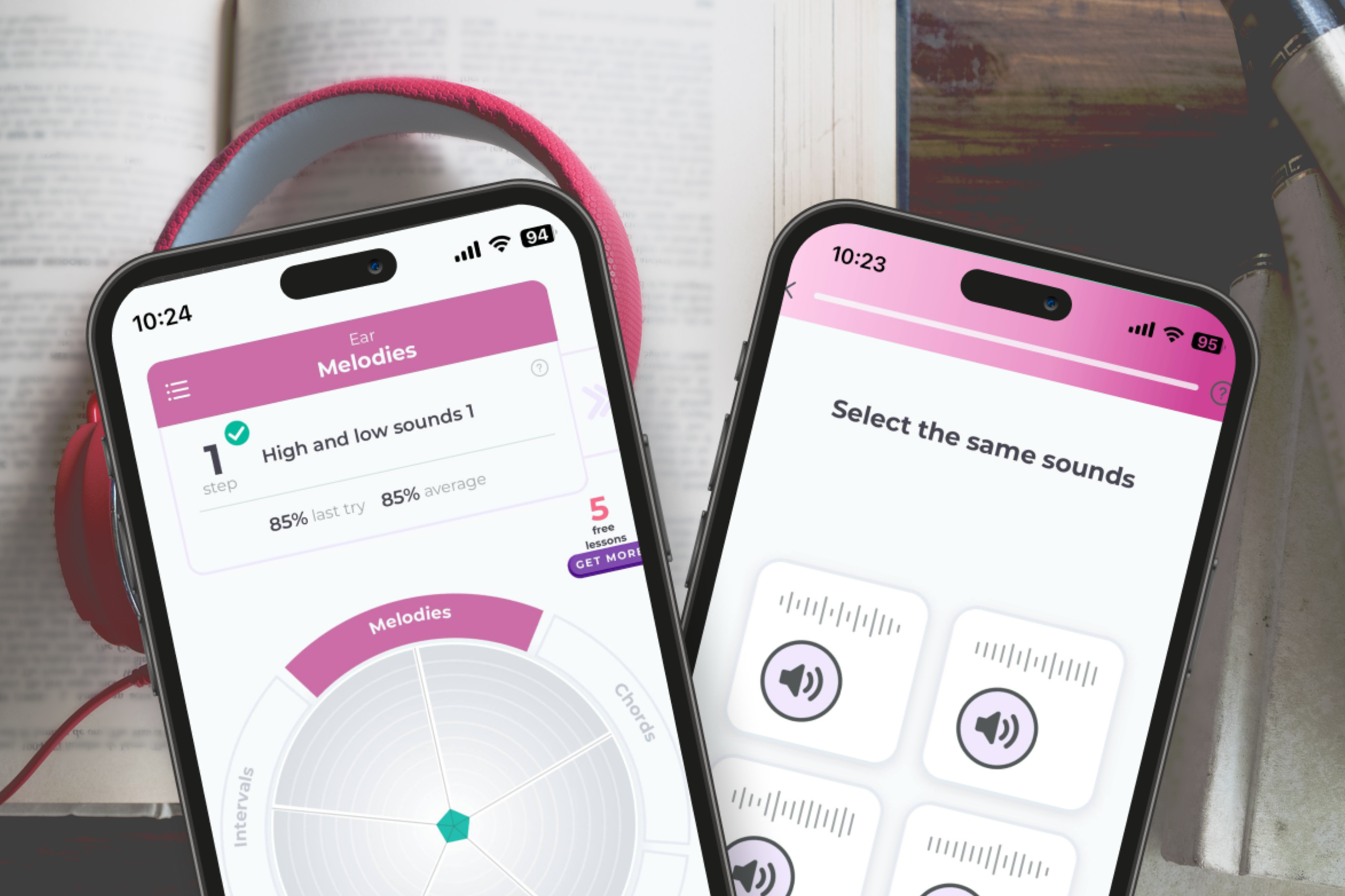
Introduction to Auditory Training Why Develop Auditory Perception
It forms the basis on which musical expertise is established. It is impossible to reach a high level of performance and to understand music without the capability of distinguishing nuances of sound, assessing the rhythm, and catching the dynamics of melody. This is where ear training, structured listening drills, the Talented app, focused interval recognition, and musical tasks like chord identification turn raw hearing into deliberate skill. For learners building a home practice stack, a free piano lesson app download can complement these aural modules with melody identification, rhythm listening, audio awareness, and pitch training.
Why, then, has auditory training become such an integral part of education?
- Attention to sound details develops.
- Our hearing is like any instrument and needs practice on a regular basis.
- Musical memory improves.
- The better the sound perception is, the easier it will be to memorize and then reproduce the sound.
- The ability for improvisation and composition increases.
- Delicate musical nuances become available for creative use.
- Fatigue in listening to or performing music decreases.
- A trained ear adapts faster to any sound situations.
It is important to understand that the auditory perception is not given to us by nature automatically. It can and should be developed systematically. Such training has an effect not only on music but also on speech perception, enhancing the ability to concentrate and pay auditory attention. It is for that purpose that a special digital assistant has been developed, focused on the most efficient solution of tasks in this area.
Here, listening practice, tone differentiation, aural dictation, and critical listening all feed long-term ear development.
A Brief Overview of the Talented Approach and the Main Benefits
Our approach is informed by a methodology which fuses compelling algorithms with sound, pedagogically tried-and-true techniques. Structured, adaptive, intuitively clear, it helps users to work with audio information in a new way.
The Major Benefits
- Personalization: the program is customized according to individual learner levels and goals.
- Multi-level exercises: from the simple differentiation of sounds up to complex analysis of melodies and harmonies.
- User-oriented interface: easy and comfortable practice both for beginners and advanced musicians.
- Analytics of progress: Real-time visual feedback helps track results.
- The integration of theory and practice: explanations accompany training and contribute to better material assimilation.
The backbone of this approach is an idea about integral ear development through various exercises that provoke different zones of sound perception. This approach allows not only sensitivity enhancement but also assures a strong connection between hearing and motor skills-important for playing instruments. It is just these qualities that make this developed solution one of the most effective tools for music education in the digital age.
Inside the Talented app, layered ear training plus interval recognition and chord identification build a chord ear for harmonic analysis and listening skills.
Principles Underlying Effective Auditory Training
Basic principles should guide the development of auditory perception so that sessions are adequately and effectively conducted. The process then becomes unsystematic and ineffective without their observance.
- Gradual load. It is not worth striving for some difficult tasks right away. The exercises should start with the simple ones and gradually complicate them, so the brain will have time to get used to new irritants.
- Active attention. When hearing an excerpt, listen to intonations, timbre, rhythmic features. The passive perception is almost useless.
- Variety of sound. The more productive the training will be, the wider the range of acoustic samples will be. Vary music, speech, natural sounds, and noise signals for all-round ear development.
- Session regularity. Not after single listening but thanks to systematicity, the effect arises. Optimal daily short sessions are 15–30 min.
- Feedback. Monitoring of the progress is needed. Tests on recognition of elements or analysis of one’s own sensations and mistakes after exercises can serve to this purpose.
Following these principles, a robust auditory skill base will be laid, along with prerequisites necessary for successful task complication.
This is exactly where listening drills and interval recognition become daily, repeatable practical exercises.
How to Complement Talented With Exercises on Perception of Sounds and Melodies
Although Talented already contains a powerful set of tools for hearing development, further exercises can significantly expand the training possibilities. The following provides an overview of several formats that can easily be integrated into everyday practice:
- Extracting sounds from the general background. Include recordings that will have natural or urban sounds, and try to make out some of the noises, such as footsteps, voices, or a car horn. This exercise develops the ability to focus and recognize nuances.
- Recognizing melodies “by ear.” Familiarize yourself with short musical fragments, trying afterwards to reproduce them by ear or to discern with which notes they are built. Such work trains musical memory and intonational perception.
- Rhythm imitation. Repeat the simple rhythmic patterns aloud or by clapping. This method is effective in coordinating hearing and movement.
- Comparison of sounds. Listen to two similar sounds and find the difference: either in the tone, duration, or loudness. Listening to minute details is what helps to develop fine hearing.
Such inclusions within the Talented program will achieve a more harmonious balance of perceptions, thus complementing and enriching the original method. It is desirable to keep a training diary, noting sensations and achievements. Such a record stimulates further development and motivation.
This kind of listening practice, paired with chord identification and interval recognition, expands aural modules into a full listening skills curriculum.
Practical Techniques to Increase Ear Sensitivity
It is impossible to develop auditory perception without regular and diverse exercises that attract attention to sounds and melodic nuances. Here are some effective techniques that will help substantially improve auditory sensitivity:
- Listening to surrounding sounds actively
Practice by spending several minutes each day paying attention to the soundscape around you. Close your eyes and see how many sources of sound you can detect: footsteps, ticking clocks, birds singing. You then develop the ability to recognize minute details, and also the ability to focus on what you hear. - Differentiation between tones and pitches
Different notes can be highlighted and remembered with the help of musical instruments or special apps. The task should gradually be complicated: from simple matching of identical sounds to the comparison of notes close in tone. - Recognition of rhythmic patterns
Tapping and repeating different rhythms should be done by hands or using available objects. Various rhythmic structures: experience shows that mastering them develops hearing and coordination. - Imitation and verbalization of melodies
Short musical phrases should be listened to and attempted to reproduce vocally or with an instrument. This practice will contribute to strengthening the memory of auditory images and improve musical-perception ability. - Listening under various conditions
Change the format and environment of listening: try perceiving the sound in silence, outdoors, or in an echoing room. Such variability will prepare the ear for adaptation and will improve signal recognition in various acoustic situations.
These techniques are classic listening drills and ear training tasks, and when run through the Talented app, they gain feedback, audio awareness, and clearer listening practice targets.
What to Expect After Systematic Training Results and Changes
Systematic auditory training is more than a set of exercises; it is a process that gradually alters the way you perceive sound, improving your inner sense of rhythm and melody. As a developer team observing user successes, we know exactly what changes to prepare for.
Well, noticeable after only a few weeks of regular sessions, hearing sensitivity does improve. What is it that changes?
Beyond these basic changes, the emotional perception of music is influenced by regular training: nuances and beauties of melodies open more deeply, often unexpectedly inspiring and a source of delight.
What to expect during the process?
First of all, there are moments of ear fatigue and slight irritation — it is a normal response to an unfamiliar kind of load. Confidence in one’s auditory abilities will eventually surface, accompanied by increased interest in the sessions.
The most important thing is regularity. Success will be slow or hardly noticeable without systematic practice.
After one or two months with surprise, you will be able to notice that music and world sounds sound quite different to your ears-brighter, deeper, and more multifaceted. This is exactly the result we are searching for, and it is the best proof of efficiency of the complex approach to developing auditory perception.
This is also when chord identification and interval recognition start feeling natural inside listening drills.

Common Mistakes and How to Avoid Them in Auditory Training
When working on developing auditory perception, especially using the Talented method combined with additional exercises, it is important to remember some common mistakes that may decrease the effectiveness of training or even lead to frustration:
- Irregular training sessions. The accumulated effect is destroyed by missed and long breaks. To avoid this, build your training schedule in advance and follow it.
- Auditory fatigue. Fatigue, caused by overly long exercises without breaks, affects perception adversely. The optimal session duration is 20–30 minutes with mandatory short breaks.
- Ignoring progress and mistakes. Without recording your successes and analyzing errors, grasping which specific aspect requires adjusting the approach is difficult.
- Repetitive sets of exercise: Doing the same exercises over and over again will surely stagnate performance fast. Variety keeps interest high and fosters auditory growth through challenges.
- Too much striving for results. Interest is undermined and stress is provoked by pressure and very high expectations. The main thing is enjoyment of the process and perception of every mistake as a significant stage of learning.
To avoid these mistakes, it is recommended that:
- Keeping a training journal, recording sensations and achievements.
- These include setting realistic goals, both short and long-term.
- Maintaining motivation through communication with like-minded people or participation in group training.
- By following a combined approach: changing intensities and types of exercise.
This kind of structure is ideal for progressive ear training, rotational listening drills, and diversified aural modules in the Talented app.
Conclusion Synergy of Talented and Extra Exercises for Maximum Effect
The combination of the unique Talented method with additional exercises for sound and melody perception opens new horizons in the development of auditory training. This complex approach develops the capabilities of the ear, including shaping its flexibility, stability, and accuracy of music and speech perception.
Only with the systematic use of Talented, combined with well-planned and diverse auditory exercises, can one get the maximum effect, expanded audio perception, and real enjoyment from the musical process. Your hearing is an instrument that can and should be trained; it’s an entertaining and effective activity thanks to the skillful combination of methods.
In practice, this means sustained ear training, ongoing listening drills, and regular interval recognition plus chord identification sessions inside the Talented app — a complete listening skills ecosystem.